Books That Come From Truth, Not Imagination
(Book 1 of the Epic Philosophies in Love, War, & Reasoning Series)
Twisted Men with Twisted Minds
A raw exploration of human contradiction, moral conflict, and the invisible forces that shape decisions in a fractured world. This book opens the Epic Philosophies book series, a five-volume collection exploring philosophy, faith, war, and human nature through poetry that doesn’t look away from hard truths.
This book moves through war, society, politics, and personal reflection to expose how easily perception is distorted and how deeply human choices are influenced by fear, power, and survival. It does not comfort the reader; it confronts them.
Built through narrative poetry and real-world observation, it captures moments where humanity breaks, questions itself, and struggles to find meaning inside chaos.
This is not a story of answers. It is a record of tension, truth, and uncomfortable clarity. Book 1 of the Epic Philosophies in Love, War, & Reasoning five-book series, where each volume stands alone yet deepens the exploration of what we become under pressure.


Hidden Glory
(Epic Philosophies in Love, War, & Reasoning Book 2)
A poetic exploration of struggle, endurance, and the quiet presence of meaning inside human suffering.
Hidden Glory moves through landscapes of inner conflict, broken systems, faith, doubt, and survival. It captures moments where life feels dry, uncertain, and fractured, and slowly reveals that even in collapse, something is still forming beneath the surface.
The work shifts between reflection and revelation. It exposes how people navigate pain, how they lose direction, and how meaning still emerges through hardship, not despite it.
This is not optimistic storytelling. It is an honest observation of the human condition under pressure, where clarity is not given but earned through experience.
In the end, Hidden Glory points to a simple truth: even in the harshest seasons, something unseen is still at work. Book 2 of the Epic Philosophies book series order: discover which book to read first and explore the complete five-volume Epic Philosophies book series.
Get Hidden Glory book paperback now!
Where My Heart Beats
(Epic Philosophies in Love, War, & Reasoning Book 3)
A story-driven collection of poetry that explores love in its most human form: imperfect, unstable, consuming, and real.
Where My Heart Beats moves through moments of connection and loss, attraction and distance, hope and emotional collapse. It captures relationships as they actually unfold, not as idealized ideas, but as experiences shaped by timing, misunderstanding, desire, and consequence.
The poems shift between intimacy and separation, showing how love can feel like both grounding and displacement at the same time. Some pieces lean into tenderness and romance. Others expose emotional confusion, regret, and the difficulty of holding onto meaning when feelings change direction.
At its core, this collection is about return and departure, what people chase, what they lose, and what remains when memory takes over.
It does not offer conclusions about love. It reflects what love does to people.
Discover Thomas S. Doland books Amazon for the complete collection and individual titles.


Face in the Wind
(Epic Philosophies in Love, War, & Reasoning Book 4)
Face In The Wind explores the invisible forces that shape human life: faith, surrender, struggle, and the search for meaning within chaos.
This collection moves through poetic reflections on human limitation and divine presence, in which life is not explained by logic alone but experienced through moments of awakening, loss, and transformation.
It captures the tension between control and surrender, showing how people are carried by forces they do not fully understand, yet are constantly being shaped by them.
Each piece reflects a journey through inner conflict and spiritual questioning, where identity is tested, broken, and reformed through experience rather than theory.
This book is about movement. Not stillness. Not certainty. But the act of being carried forward by something greater than human understanding.
It does not argue. It reveals.
Book 4 of the Epic Philosophies series. Discover Face in the Wind poetry book Amazon and explore all five volumes of this transformative collection.
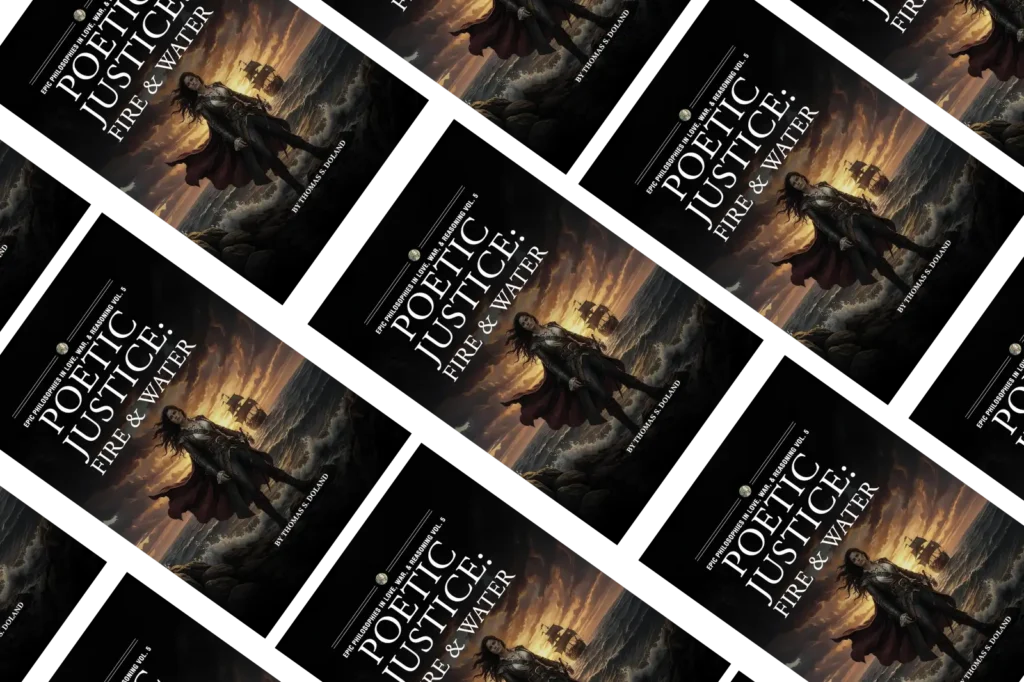
Poetic Justice: Fire & Water
(Epic Philosophies in Love, War, & Reasoning Book 5)
Poetic Justice: Fire & Water is a confrontation between opposing forces inside human existence. Love and destruction. Truth and deception. Power and collapse. Faith and moral decay. This is philosophical poetry books at its most uncompromising, exploring what we become when belief systems collapse.
Through narrative poetry and philosophical storytelling, the book moves across battlefields, cities, memories, and imagined worlds to expose how human decisions shape both personal fate and collective ruin.
This work explores one central conflict: what happens when human desire collides with consequence. Every poem becomes a scenario in which belief systems are tested under pressure, and morality is not discussed but lived through collapse, resistance, and realization.
Fire represents impulse, ambition, war, and destruction. Water represents reflection, surrender, truth, and cleansing. Between them lies humanity, constantly shifting, constantly choosing, constantly paying for what it believes.
This book does not comfort the reader. It confronts them. It does not simplify reality. It breaks it open. Book 5 of the Epic Philosophies series, the final volume in Thomas Doland books collection. Complete your journey with the Epic Philosophies complete set.